
When I first began teaching, the most commonly asked question was “Miss, what’s next?”
It was not just one child, it was the majority. Some wanted reassurance, others just wanted to know how close they were to lunch time. I also observed that for some children, the uncertainty of the structure of their day negatively impacted their focus in the classroom.
At first, I found repeating the day’s structure a chore. I had said it aloud and it was written out in big letters on my whiteboard. However, I realised that this was not good enough. My pupils needed to SEE it.
I had used visual timetables in the past when I had been tutoring SEND or Early Years pupils, and they had been effective. But in a busy classroom, especially in Key Stage 2, I was unsure if using my visual timetable would be practical or effective.
Whilst considering implementing this strategy in my classroom, I began to notice patterns:
- Children became unsettled as the lessons began to end
- Transitions between lessons and after break were difficult for some children
- Some children became anxious when the plan for the day changed
- It was not just the children with EHCPs or support plans who wanted to know which lesson was next
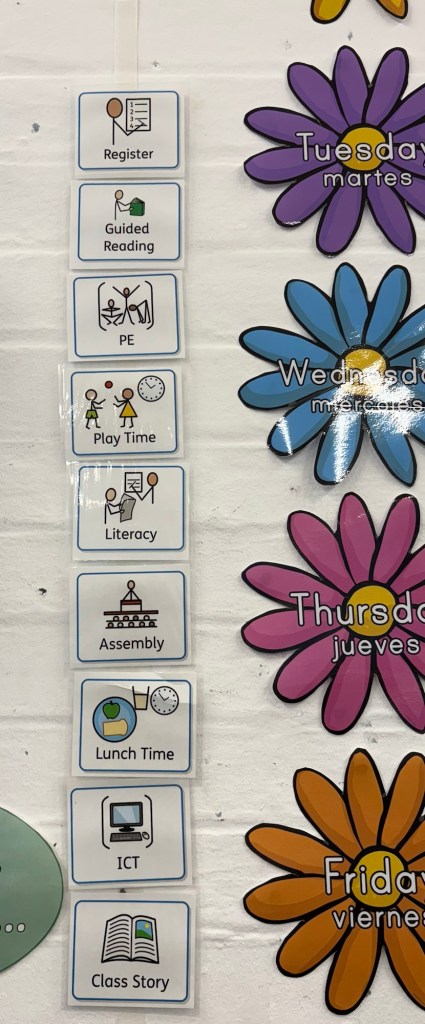
I realised that visual timetables, although usually associated with targeted, individual interventions, would be universally useful for my class. Using Widgit, I created my own visual timetable on my wall.
The difference was immediate. Transitions became smoother, and I found that those repeated questions significantly decreased. What surprised me most was how universally beneficial it became. Children with no identified additional needs were just as engaged with the visual timetable. Some even wanted to help organise the schedule for the next day. It created predictability and a shared understanding for everybody in class.
What I initially thought would be a strategy for a few children, became a universal strategy for learning. It reminded me that inclusive teaching is not solely about meeting individual needs, but designing an environment where all children can thrive.
 All Kinds of Clever
Leave a comment